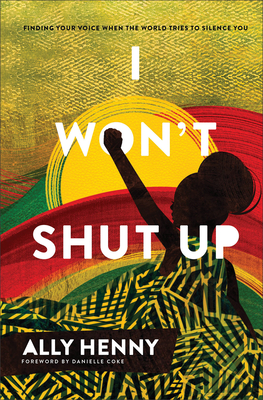
I have followed Ally Henny, author of I Won’t Shut Up: Finding Your Voice When the World Tries to Silence You (pub. June 20, 2023) on social media for several years, and am so glad that she hasn’t shut up!
This memoir is a welcome addition to first-person accounts of the racism that, unfortunately, still exists in majority-white spaces. Henny has written powerfully about what she has experienced in white Christian organizations, and how she found her voice despite having to deal with the subtle and not-so subtle acts of exclusion that were continually thrown her way, by people who professed to be Christian.
She talks about growing up in a rural, primarily white school environment, coins the term “superminority” (where the population is at least 80% white) and how she fought to maintain the belief in herself that she felt with her immediate and extended family. She states:
Growing up as a superminority taught me that racism is such a part of white culture that they don’t even consider their behavior to be racist.
She also coins the term “white noise”:
White noise is The Racist Way That Things Are. It is the overarching presence and compounding effects of racism. It’s the subtle shush of white supremacy that can lull us into accepting oppression as normative. It is a whiteness-dominated culture that rewards assimilation and oppresses anyone who doesn’t or can’t code-switch. It’s an environment in which speaking against racism causes far more offense than people being racist. It’s the myriad injustices and inequities that we observe on a regular basis. It’s all the so-called microaggressions, the small, seemingly insignificant things—like your body always being poorly lit in a group pictures, or people cutting in front of you in line, or having to do your own makeup for the school play, or having to pay extra to get the Black channels on cable—the “little things” that compound into a constellation of harms over time. Every so often, white noise becomes the harsh static of overt racism that leaves us flailing as we attempt to hit the mute button and change the channel to a less racist station.
She also discussed feeling “unpretty” because of white beauty standards, and how she dealt with rejection as a middle schooler. I so appreciated this discussion, as there are so many parallels with anti-fat bias (since anti-fatness originated and is related to anti-blackness), and rejection by one’s peers at that stage of one’s life can last for a very long time.
As a faith leader, she is hopeful:
This is the essence of liberation: being seen in the fullness of who you are and being free to love and express yourself in a way that brings light and life to others.
As you find and grow into using your voice, remember that liberation is the goal. Allow your voice to be the thing that speaks life over others and brings them into the light of freedom.
I highly recommend it, especially for those involved with churches, and thanks to NetGalley for an honest review in exchange for an advance copy.
 Reading While Fat