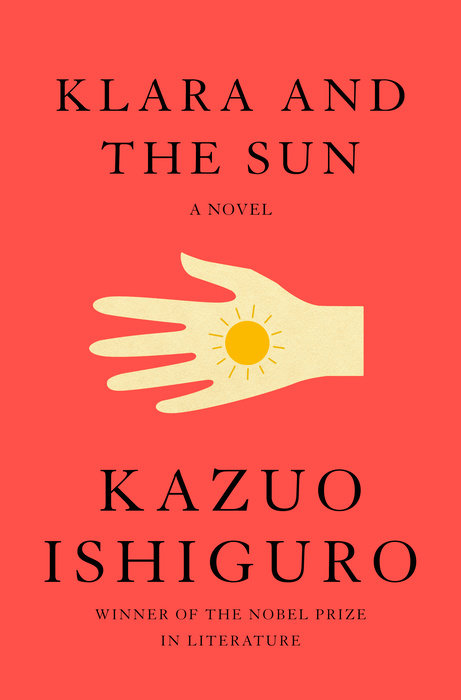
Klara and the Sun (2021) by Kazuo Ishiguro (The Remains of the Day, Never Let Me Go, The Buried Giant, among many others) was on the to-read list in my head for a while, so I was glad when it was our book group selection for May.
As the book begins, we learn that Klara is an Artificial Friend robot, or AF, and she lives in a shop in a large city with other AFs waiting to be purchased by the families that pick them so they can be companions for their children. The sun is very important to AFs, as they run on solar, and the locations in the storefront are much desired, as they get the most attention by families seeking to purchase an AF and they get the “life-giving” rays of the sun while they’re there. Another reason that Klara loves the storefront is that she gets to observe life outside the store, on the street beyond.
Told entirely from Klara’s perspective, she is child-like, but also wise, as she seems to have greater perception than the other AFs. One day she sees a girl, Josie, outside the store, and notices that her walk is different than most other humans. They have a conversation, and Josie promises to come back after she can talk her mother into bringing Klara home.
After what seems like a very long time, Josie returns after Klara has been moved to another part of the shop, and thus begins Klara’s life as Josie’s AF. We learn that Josie has been ill, her parents are no longer together, and her mother works a lot. They have a maid, and Klara and Josie are able to watch the sun go down from Josie’s bedroom every night. Klara’s job is really only to keep Josie company, which she does, despite Josie’s periods of illness. They spend time with Rick, the boy next door, whose prospects for his future are limited because he did not go through the genetic enhancement “lifting” process that we find out is the cause of Josie’s illness, and which also killed her older sister.
It’s a quiet book, but I was drawn in to this world that has so many similarities to ours, and seems to be one possible way we could be headed. I was also amazed at the religiosity of Klara in the way that she viewed the sun–one of the major plot points revolves around Klara praying to and making offerings to the sun to heal Josie so that she won’t be sick any more. She believes in the curative properties of the sun and is totally devoted to Josie, so she sacrifices parts of her very self in the true belief that it will cure Josie. In contrast, we find out that Josie’s mother is so afraid of loss, that she is contemplating doing something that will ensure she will never lose Josie like she lost her sister.
I really enjoyed it–it reminded me somewhat of Ishiguro’s 2005 Never Let Me Go, which was about clones, though we don’t find that out in the beginning. It’s a great pick for book groups–it kept us talking for the entire time about the various possibilities and meaning of the characters’ actions. I highly recommend it, and there was no anti-fat bias, so consider it weight neutral.
 Reading While Fat