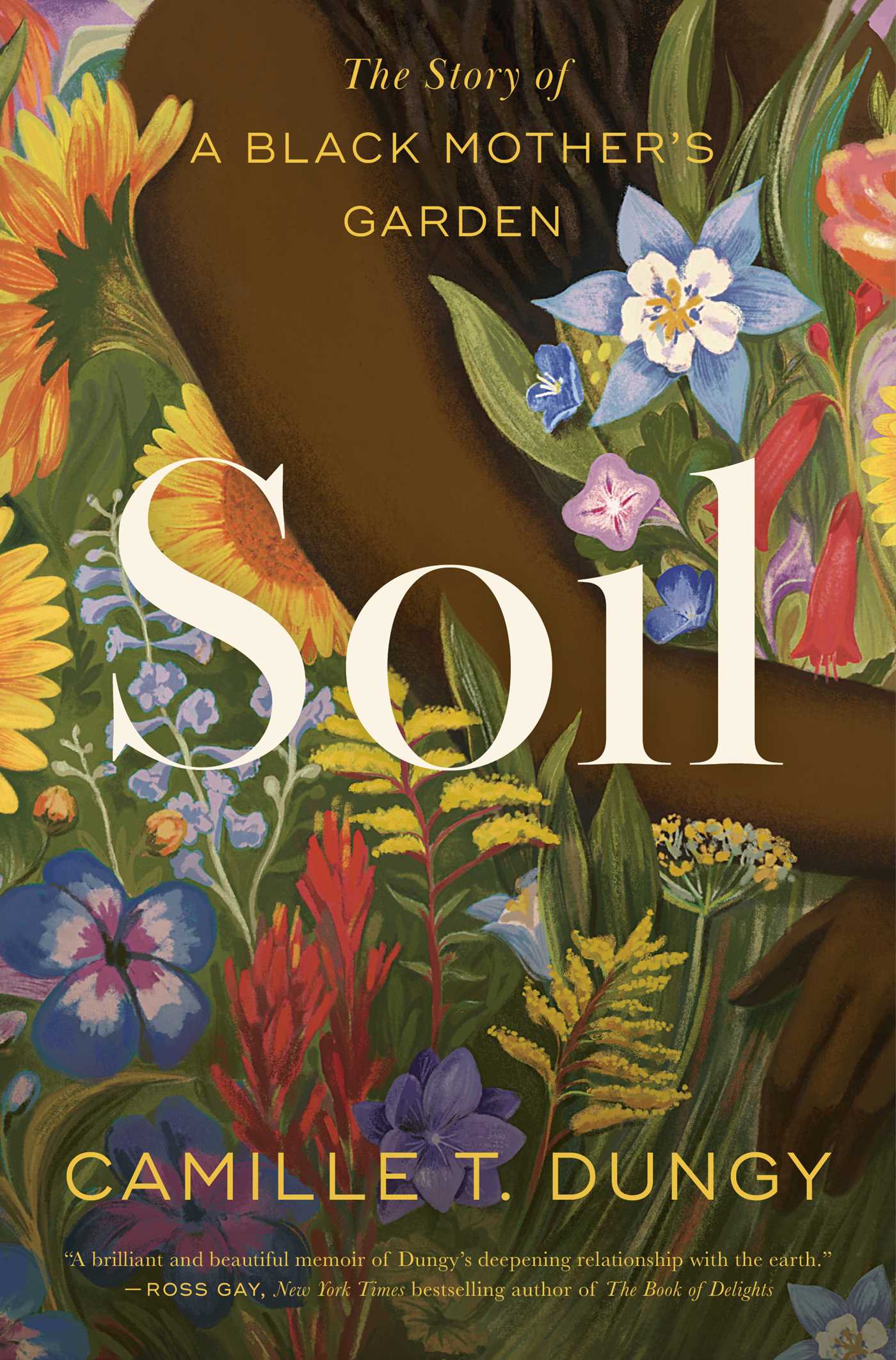
I loved Soil: The Story of a Black Mother’s Garden (2023) by Camille T. Dungy so much that I had to buy my own copy after reading my library copy. Soil really defies categorization–it’s a memoir (much of which she wrote during the COVID-19 pandemic), but she also writes about black history and social justice because it’s all connected, It’s nature writing, and it’s about motherhood. There are beautiful poems and photographs from Dungy’s garden in between chapters, and a map of her garden on the endpapers inside the front and back covers.
It’s so beautiful that I want to savor it again and again. And it’s heartbreaking, too, when Dungy writes about the terror of being black in the United States. White people cannot and should not look away.
As the book opens, Dungy is moving to Fort Collins, Colorado, at the edge of the prairie in sight of the Rocky Mountains. Seven years later, she wants to convert part of her lawn to a drought-tolerant native flower field and she and her husband need to deal with a truckload of mulch dumped on the street before it is blown away. She is awarded a Guggenheim Fellowship where she wants to write about her garden, but instead the time she would have had is taken up by virtual schooling of her daughter and the anxieties of the COVID-19 pandemic.
Her words about motherhood and trying to perform any creative activity are so relatable and truthful.
Maybe I don’t see mothers in the canon of environmental literature because it’s impossible for most mothers to create a world where they have nobody to think of but themselves. . . Why doesn’t anyone in foundational environmental literature seem to have to do the dishes?
Soil: The Story of a Black Mother’s Garden, by Camille Dungy
She writes about Annie Dillard and Pilgrim at Tinker Creek; about Lucille Clifton, her favorite poet, who had 6 children under the age of 10 for several years in the late 1960s. When her daughter comes home after learning about the idea of manifest destiny, that shaped and is still shaping our country, Dungy writes about it.
Which needs, which lives, which wills, which words, which stories, ought to have priority? These are the questions I return to, like I return to these pages about my garden, puzzling over what gets my attention, and in which order.
Soil: The Story of a Black Mother’s Garden, by Camille Dungy
As 2020 continues, Dungy writes about the senseless killings of black people, and what it means to be the mother of a black child. And most white people still don’t understand–after a public reading from one of her books, a white woman asked her how she could fancy herself an environmental writer when she writes so much about African American history.
I did not understand how I could write about history without accounting for the environment out of which history springs. . . No matter how many years have passed, no perennial in life’s garden roots more deeply than history.
Soil: The Story of a Black Mother’s Garden, by Camille Dungy
Please, please read Soil, if you have any interest in gardening, or parenting, or history. You will find something to love in Dungy’s words. I will be reading it over and over again. I don’t recall any anti-fatness, so consider it weight-neutral.
 Reading While Fat