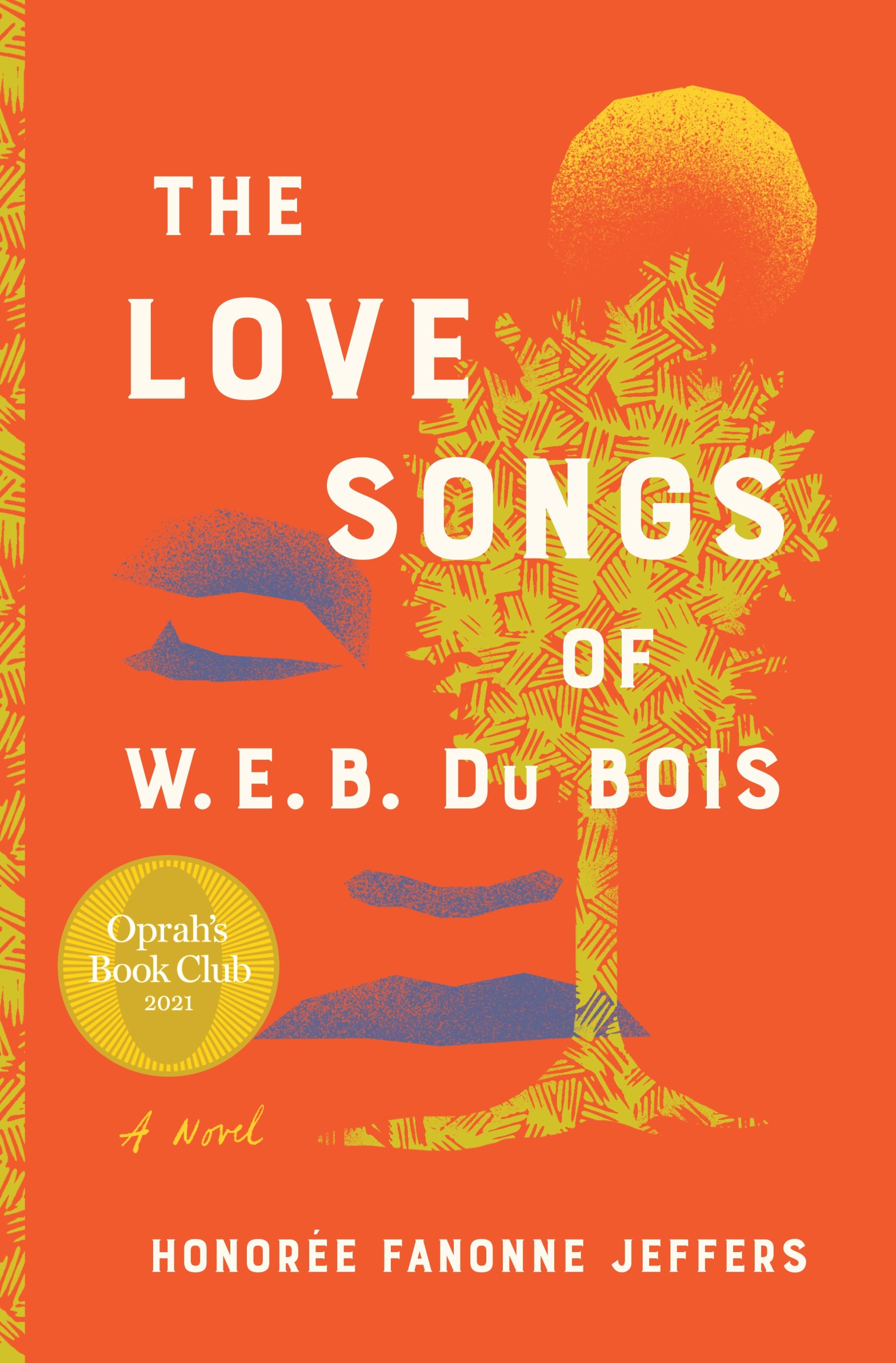
The Love Songs of W.E.B. DuBois (2021) by Honorée Fannone Jeffers was an Oprah’s club pick, a finalist for the Kirkus prize that year, along with several Goodreads nominations, and I’m disappointed that it wasn’t honored more. Overall, it’s a sprawling, beautifully written, epic work of historical fiction, poetic and heartbreaking and intricate. At nearly 800 pages, 30 hours on audio, and spanning over 250 years, it’s a book to sink into.
Jeffers weaves chapters told from the first-person perspective of Ailey Garfield, born 1969, with third person chapters of her older sister Lydia and their mother Belle, along with “Songs” telling the stories of the Indigenous, African, and white ancestors who lived on Belle’s family’s land in rural Georgia from the late 1700s. Ailey is raised in “the City”–we never find out exactly which one–but her heart is in Chicasetta, the small town where she, her sisters, and her mother spend the summers with their grandmother, Uncle Root, and the rest of the family.
Some of it was hard to read–portrayals of sexual abuse of young girls during multiple generations, and crack addiction, and grief. But it was all part of the story, and nothing was gratuitous. Jeffers tells the story of this country through Ailey, the women of her family, and her great-Uncle Root, a history professor who was the son of a white man and a black woman, born in 1906, when it was not legal for his parents to be married in Georgia.
Jeffers addresses colorism in the Black community outright, which affects everyone in her family differently. The mystery at the heart of the novel is masterful–how Ailey comes to discover the truth about her family and their relationship to Routledge College–her and her parents’ alma mater, where Uncle Root was faculty for nearly 40 years–was gripping.
There is some anti-fatness in that Ailey is described as chubby, and goes up and down in weight, but Ailey is also the main character, and her weight does not seem important to her, nor does it affect her relationships with men, with her family, or her work. So in that sense I think it could be considered fat-positive. There were a couple descriptions of people being fat, but it was not done in a negative way, just factual descriptions, and one of Ailey’s boyfriends was a big guy, and Ailey was very attracted to him and his size. Overall, I’d consider it to be mixed anti-fat and fat positive. Otherwise characters’ body sizes weren’t described–the author described their height, and their skin tone or hair more often if a physical description was needed.
I highly recommend The Love Songs of W.E.B. DuBois. It’s the story of this country. My words cannot really do justice to the beauty of this novel.
 Reading While Fat