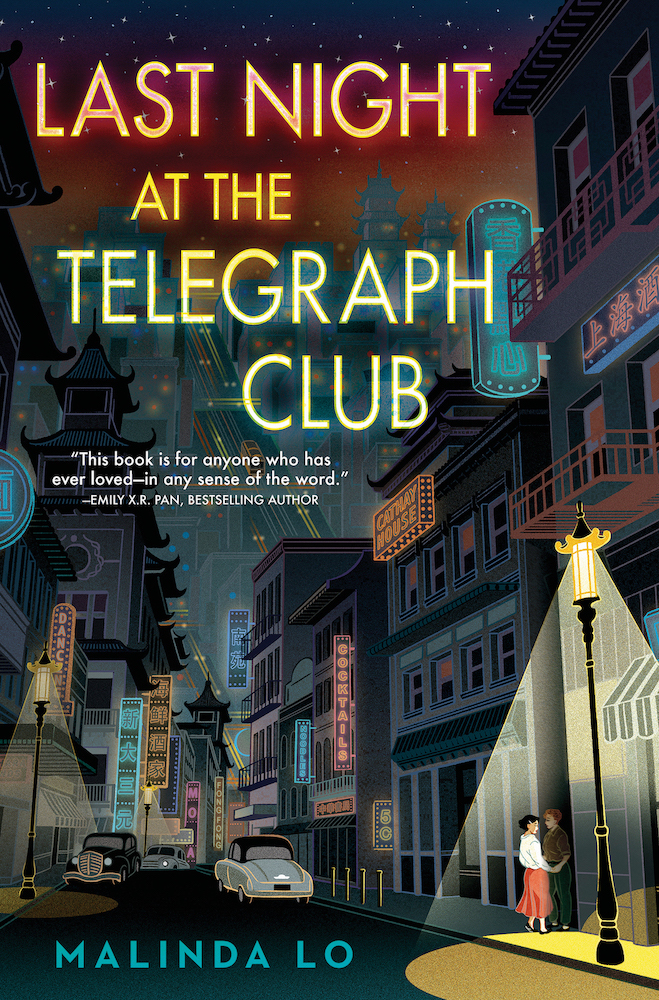
Last Night at the Telegraph Club (2021) by Malinda Lo is an award-winning queer young adult historical romance/ thriller set in 1954 San Francisco, featuring Lily Hu, a Chinese-American high school student who discovers that she is not like most girls because she likes other girls.
Lily has spent most of her life sheltered in the Chinatown community with her father, who is a doctor, and her mother, a nurse, and two younger brothers. But her aunt works for NASA in southern California as a computer and she’s dreamed of space and has devoured science or space-related books and magazines since she was small. She’s always had math classes with Kath Miller, a white girl, but they’ve never really talked. At the beginning of their junior year, a group project brings them together and she finds out that Kath is obsessed with flying and wants to become a pilot. At the same time, she sees an ad for a “male impersonator” who performs at a club near Chinatown called the Telegraph Club, and sees a dime-store pulp novel about two women falling in love, and she can scarcely believe something like that is possible.
All of this is set amid the backdrop of the red scare of the 1950s, the fear that Chinese people have Communist sympathies, and real threat of deportation of her parents. Her childhood best friend keeps trying to set her up with boys, and Lily doesn’t know how to tell her that she’s not interested. Kath has been to the Telegraph Club, and she takes Lily, beginning their secret romance.
I loved the characters, and the plot completely engrossed me. I was rooting for Kath and Lily even though the time they lived made things very difficult, not only to be a woman with career aspirations, but to be a queer woman. Lo made me want to go back to San Francisco and take a queer historical tour and go back to Chinatown so I could see the places described so vividly.
Although there were no fat characters, it was completely free of anti-fat bias, so I consider it weight-neutral. I highly recommend it!
 Reading While Fat
2 thoughts on “Last Night at the Telegraph Club”