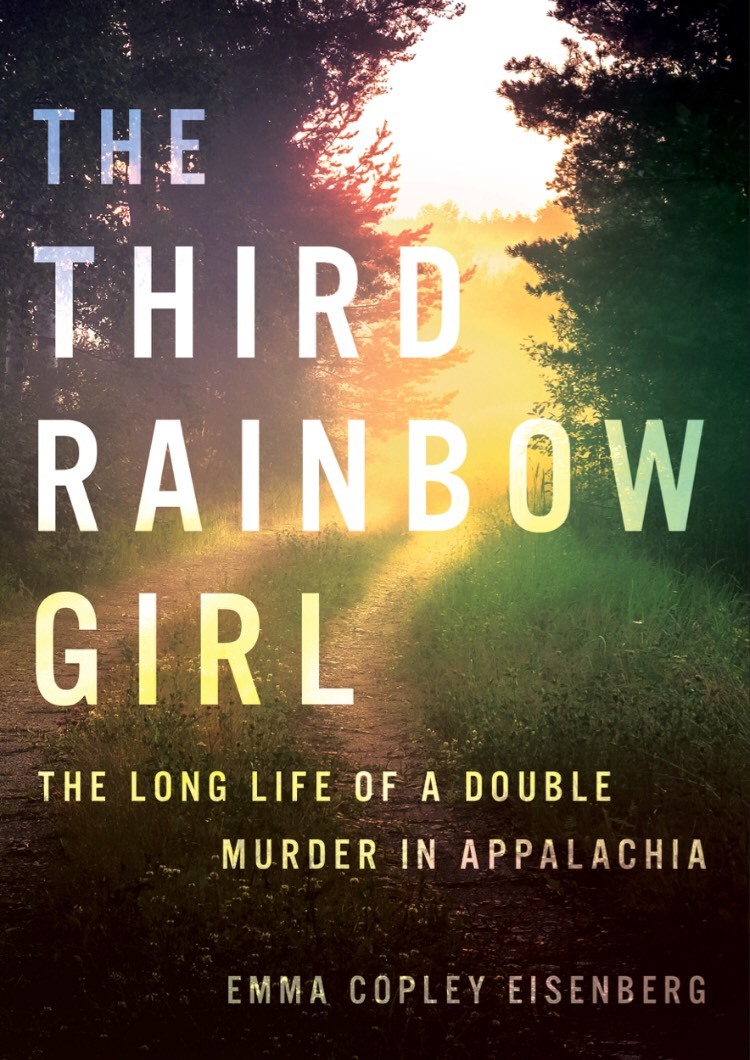
I sought out The Third Rainbow Girl: The Long Life of a Double Murder in Appalachia (2020) by Emma Copley Eisenberg because of her brilliant 2024 novel Housemates, even though true crime is not a genre I often choose to read. The Third Rainbow Girl is more than just true crime, though, as Copley Eisenberg includes elements of memoir and close observation of the residents during her time in Pocahontas County, West Virginia.
Copley Eisenberg has also written about anti-fat bias in fiction on her brilliant Substack, Frump Feelings, so I wanted to see how she dealt with it in her first book. It’s also an Edgar and Lambda nominee.
On the border with Virginia, Pocahontas County has no interstates, currently has a population of less than 10,000 people, and is within the US National Radio Quiet Zone, an area in West Virginia and Virginia where radio transmissions are restricted to facilitate scientific research and intelligence-gathering, including cell phone and wi-fi use. All that to say: It’s remote and off the beaten path.
In 1980, two young women, visiting Pocahontas County for a “Rainbow Gathering” of hippies, were murdered. There was no evidence of sexual assault and there was little evidence of them having spent much time there before the murders. The murders greatly affected the community, turning residents against each other, and there was no prosecution for thirteen years, until a local farmer was prosecuted. However, while the local resident was serving time, a known serial killer, who had been passing through Pocahontas County at the time of the murders, claimed responsibility, so the local farmer was released.
Copley Eisenberg, who had been raised in New York City, learned a lot in Pocahontas County, and it’s clear that she grew in her understanding of the world while she was there and in the process of writing the book. She also wrestled with compulsory heterosexuality, binge drinking, and depression.
From some of the things she wrote, I think what intrigued her most about the murders, and why she had to write about them, was because of the descriptions in the 1992 coverage of the trial about the murdered girls and how they were “not very pretty.” They weren’t described as fat, but were described as “bigger and heavier than average” and the first man to be convicted of their murder described them as “not they type of women I’d want to have sex with . . . they weren’t the slimmest, trimmest little things.” Just as our country has wrestled with the lack of attention spent on resolving (or worse) murders of people of color, I think by writing this book, Copley Eisenberg was trying to bring attention to two things: First to the murders of these women whose bodies didn’t fit the dominant narrative of having been murdered because they were desirable; and second, to the place where something like that could happen, that she clearly grew to love in its remoteness.
So I would recommend it, as an alternative to that other book about Appalachia that has recently become popular again and which I will never read.
 Reading While Fat
One thought on “The Third Rainbow Girl”