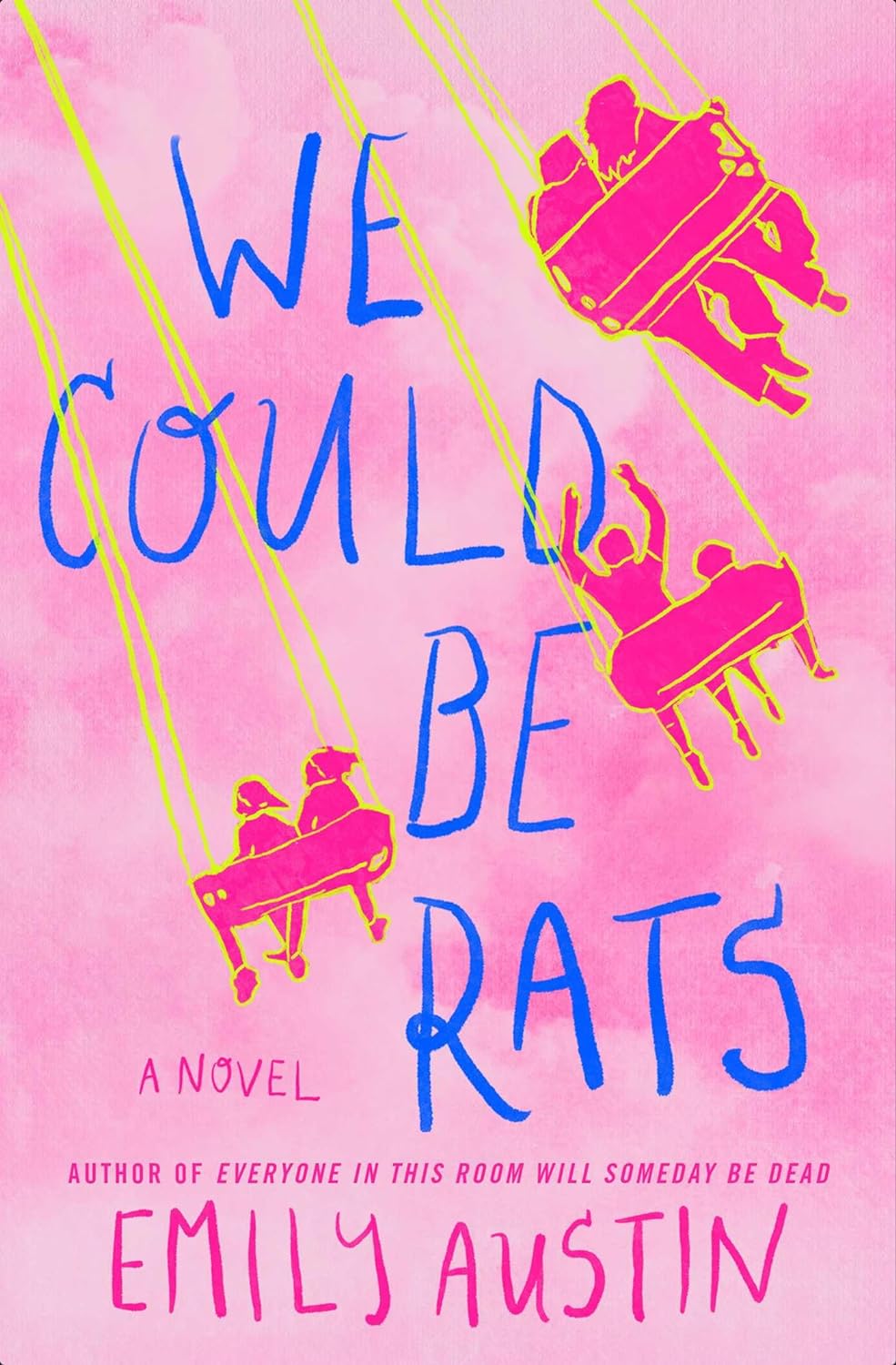
We Could Be Rats (publication date January 28, 2025) by Emily R. Austin (Everyone In This Room Will Someday Be Dead) is a uniquely-told literary novel about two sisters, Sigrid and Margit, who still both have significant trauma and mental health issues from growing up in a conflict-ridden home.
The title comes from a story told in the beginning of the novel, that Sigrid heard about a rat at a fair, gorging himself on the tons of leftover food he could find (sounds a lot like Templeton from Charlotte’s Web) and how he found so much joy in that, and that we humans should do the same thing–find days where we can be so joyful and “eat up the world” as well.
Unfortunately, both Sigrid and Margit are far from joyful, despite their different circumstances. Sigrid didn’t finish high school and is working at a “dollar” store, while Margit is in college studying literature. Although they were close as kids because of their shared trauma, they haven’t been close in a long time.
The uniqueness is that the first part of the book consists of suicide notes written by Sigrid, titled “Attempt 1” and so on. The second part of the book is from Margit’s perspective, as she found Sigrid unconscious and spent time with her in the hospital after her suicide attempt. There is a bit of a twist that I’ll leave for you to discover.
Austin’s writing is beautiful, and it’s one of my favorite kind of books–full of wise quotes from the characters as they are ruminating about their lives–from the nature of childhood and imagination to dealing with people who disagree with you on fundamental matters. Sigrid is a lesbian, and she has struggled with continuing to live in her conservative small town, dealing with her conservative family, and the opioid addiction of her best friend. And, though neither have to live with the conflict between their parents any more, Sigrid, at least, continues to feel like no one in their family understands her.
Austin acknowledges anti-fatness and diet culture, and notes that at least Margit is concerned about her weight. In another passage, Austin acknowledges individual’s differences in perspective, specifically about weight and dieting. I can’t say it’s fat positive, because there’s no clear description of a character’s size as fat, but it is definitely weight neutral, and I appreciate a direct acknowledgement of diet culture and different perspectives when it comes to body size.
If you’re up to a novel about suicide and mental health, growing up in a high-conflict family, and sisterhood, I highly recommend it!
 Reading While Fat
2 thoughts on “We Could Be Rats”