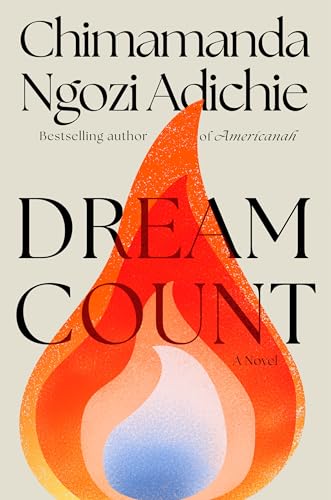
Dream Count (publication day March 4, 2025) is Chimamanda Ngozi Adichie’s first novel since 2013’s Americanah. Like Americanah, the setting of Dream Count goes back and forth between the United States and Nigeria, but Dream Count follows four African women, three living in the United States and one in Nigeria.
Chiamaka’s story begins and ends the book, during the pandemic lockdown. She is a travel writer, daughter of a wealthy Nigerian family who is able to travel independently and does not need to make a living from her writing. She has dated widely, has had relationships with men all over the world, of all nationalities, but still yearns to be truly known. Her good friend is Zikora, whose story begins when she is in labor. She is also Nigerian, a lawyer at a large firm in the U.S., who was left by her boyfriend when he found out she was pregnant. Her mother, who she hasn’t really been close to, comes for the birth, and Zikora learns more about her mother, who is the head of a primary school, than she knew from her memories.
The heart of the novel is Kadiatou–Kadi’s story. Kadi cleans and takes care of Chiamaka’s house while she travels. She is from Republic of Guinea, and a lot of her story is told as a flashback to her childhood and early life there, where she lost her father in a mining accident early, and she and her sister were forced to undergo female genital mutilation. Her sister dies during a medical procedure, and she is forced to marry, though the man she loves, Amadou, has gone to the United States. Kadi becomes pregnant, but her husband also dies in a mining accident. She names her daughter after her sister, learns how to cook, and lives with an aunt. Eventually Amadou returns for her, and she seeks asylum, which is granted by the United States. There, she finds out that not everything is like Amadou has said, and he ends up in prison on a drug charge. But Kadi meets Chiamaka, works at a hotel as a maid, and is happy with her life, as her daughter is doing well and living an American life. But then Kadi is assaulted by an important hotel guest, and her life spirals out of control with the U.S. justice system and how sexual assault victims are treated by it.
Finally, the last woman whose perspective we get is Omelogor, although we’ve seen her from the others’ perspectives from the very beginning. Omelogor is Chiamaka’s cousin, and has stayed in Nigeria, working in banking. She did spend some time in graduate school in the United States, but the cultural differences were too difficult and she became depressed. Her best friend is Jide, a gay man who can’t be out in Nigeria, and Omelogor hosts dinner parties for various groups of friends. She is in deep in the financial world in Nigeria, laundering money for very important people, but she finds a way to use it to help women in her home village. She is steely and uncompromising, but when an aunt says she can’t be happy living the life she is living, single and childless in her mid-40s, she really thinks about it.
I enjoyed learning the four different perspectives these women had of the world and how the each dealt with what was happening, with the pandemic, and with what happened to Kadi. It was not plot-driven, but I felt that Adichie really delved deeply into each character.
I believe it is generally fat positive, as Omelogor is “blessed in the front and back” and Kadi mentions how Amadou loves her wide hips, but diet culture has creeped in somewhat as there is mention of “hip dips” and Kadi not wanting to be “too big.” So I’m going to categorize it as “Mixed fat positive and anti-fat.”
 Reading While Fat
One thought on “Dream Count”