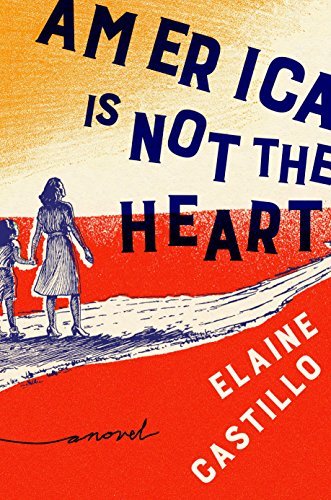
I thought Elaine Castillo’s How to Read Now: Essays was so important that I needed to read her first novel, America is Not the Heart (2018). It was utterly absorbing and did what my favorite novels do–immersed me in a world that I could not otherwise experience as a white person.
Castillo switches perspectives, specifically using the uncommon second person perspective in a couple of chapters, and does not cater to readers who are uncomfortable with non-English words, here in three languages–Pangasinian, Tagalog, and Ilocano. The main characters are Paz, born in the Philippines, her husband Pol, their U.S.-born daughter Roni, and Pol’s niece Hero, who comes to live with Pol and Paz in the Bay Area to take care of Roni, who seems to be about 7 or 8 years old.
Paz is a nurse, supporting her own family and many of the extended family, both in the U.S. and back in the Philippines, working double shifts almost every day. Pol was an orthopedic surgeon in the Philippines, but is not able to get licensed in the U.S. so works as a security guard. Hero started medical school back at home, but left to join the resistance to the Marcos regime, living in remote areas and acting as their doctor. But she was eventually captured and spent years in a prison camp, where she was tortured. Her parents don’t want to have anything to do with her when she is released, so she goes to visit her beloved uncle Pol and ends up staying.
When she starts spending afternoons after school with Roni, she realizes that Roni is getting into fights, and has severe excema, so Paz sends her to a bruja, a faith healer named Adela, who runs a restaurant with her husband, Lolo Boy. There, she meets Rosalyn and Jaime, Adela’s grandkids. Rosalyn is a makeup artist and also helps in the restaurant, and introduces Hero to the wider Filipino community, while also falling in love with her. Hero also becomes good friends with Jaime
I really loved Hero’s character and the way she made a life for herself after losing just about everything. I loved Hero’s and Rosalyn’s queer relationship, that Hero was unapologetically bisexual, and that Roni, the child that was Hero’s namesake (both are named Heronima) became possibly the most important person for Hero. It was weight-neutral–there was discussion of an ample hip or larger belly after many years, in character’s descriptions, but the body descriptions were done neutrally.
 Reading While Fat
One thought on “America is Not the Heart”