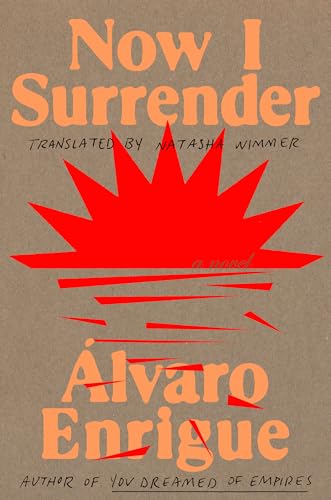
Now I Surrender (English publication day March 3, 2026, original Spanish 2018) by Álvaro Enrigue, translated by Natasha Wimmer defies genre. It is historical fiction, set mostly in the 1800s during the Apache wars in the desert southwest where the borders between the United States, Mexico, and “Indian territory” changed often.
But there are multiple storylines telling stories of Geronimo and his eluding the Mexican army and capture by the U.S. Army, an earlier storyline about a Mexican woman taken by the Apaches who decides to stay with them even after being found by an army captain after a long pursuit, and what are memoir-like interludes from the near-present, telling the story of a Mexican writer/professor taking his family on a road trip to visit Geronimo’s grave, and then through the U.S. portion of Apacheria–where Arizona, New Mexico, Sonora, and Chihuahua meet and where the last Chiricahua Apaches stayed as long as they could until they were put on a train, surrendered to the United States.
It is a Western that criticizes colonialism and U.S. history. I highlighted many, many sections with poignant and true quotes. It’s worth reading to learn about a time in history and an area that I had little familiarity with. The writing and translation is truly brilliant and incisive.
That being said, I struggled to get through it–it was very long, and towards the end there were a lot of cryptic telegrams between the Army officers in the west and Washington and the orders regarding Geronimo that slowed things down for me. Also, towards the end, the story switched between the multiple storylines almost sentence by sentence, which was a little difficult to follow.
I was annoyed by the author’s first description of Camila, the woman taken by the Apaches, because in my opinion, it was clearly written by a man. There also is some description of an army officer called “El Gordo” because of his body size, so it is anti-fat. Overall, although there are few women characters, most of the characters are men.
So, if you have an interest in the desert southwest of the U.S. and the history of the area in the 1800s, with the relationships between the Apaches, Mexico, and the United States, I would recommend it. But otherwise you might find it difficult to get through.

