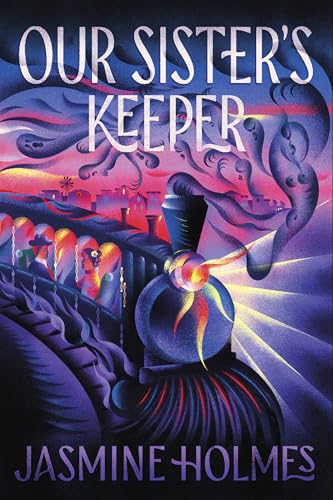
Our Sister’s Keeper (publication day June 9, 2026) by historian Jasmine Holmes is a superb historical fantasy/ horror novel set in a fictional 1920s Mississippi town called East Cobb. East Cobb is the black sister to the white town of West Cobb, and it’s different than most–it’s thriving and everyone seems happy.
Thea and her husband Kid, both from Washington DC, arrive in East Cobb one morning because Kid had interviewed for a teaching position in the high school and they agreed to try it out. The first strangeness that Thea notices is that she has to get a vaccination upon arrival, but more strange things keep happening, including screams that seem to come from nowhere, and that quickly turn into visions of abused or injured women that no one else seems to acknowledge. And though she is college-educated and has been working on her writing, it doesn’t seem like anyone in the town wants her to be anything but a housewife.
In alternating chapters, we also learn about East Cobb from Marah’s perspective–she lives in a house with Miss Clothilde and several other girls–but it is not a brothel. The girls and Miss Clothilde take the burdens off of the men in town through some process developed by Dr. Grimm, a white doctor who teaches them about the “gift” they can give the men of East Cobb, which involves the girls holding the mens’ hands and the men pouring their hearts out about the horrible things they’ve experienced, which the girls then experience, including the emotions and physical pain. This leaves the men feeling like their burdens have been lifted, free to be men and making it so their wives don’t have to carry the burdens either.
Thea keeps seeing more and more–the Groanings, she calls them–the ghosts of the women who have carried the burdens of the men of East Cobb. And she can’t tell Kid about it because he seems to really love it there–she doesn’t want to be another burden to him. But she realizes that the entire town is built on the lives of these women–the burden-bearers.
It is so well-done, with a twist I didn’t see coming. It has some similar themes with Tananarive Due’s The Reformatory in all of the best ways. I couldn’t stop reading and had to find out what happened. I highly recommend it, although I must warn about some anti-fat bias in that both groups of women–the burden-bearers and the wives–are expected to remain thin, and Thea uses a man’s body size to retaliate against some comments he had made to her. I wish Holmes hadn’t included those details, but they are realistic for the time period, unfortunately.

