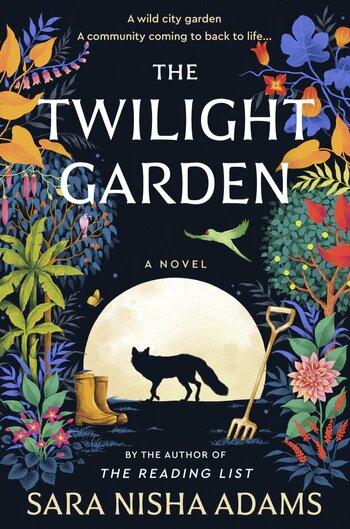
I was a big fan of Sara Nisha Adams’ The Reading List (2021) and so when I saw she had a new book, The Twilight Garden (2023), I knew that I had to read it, and I was glad that I did.
Sometimes you just want a book that takes you somewhere else into someone else’s life, where you can look at their problems and know exactly what they need to do and experience how it plays out for them. But nothing is too terrible and they experience growth and change through community. That’s The Twilight Garden, in a nutshell.
The book begins with Winston’s perspective–he is a 20-30ish young Indian man living in a house at 79 Eastbourne Road in London with his partner, Lewis, who works constantly, so they hardly ever see each other. Winston works in a corner shop pretty close by, and their house, which is half of a duplex with a shared garden in back, has been just theirs for a long while, but recently, a divorced mom (Bernice) with a tween boy (Seb) has just moved in next door, and she’s very . . . particular about what should and can be done in the shared garden.
Then we go back to the 1970s and 1980s and meet Maya and Prem, a young couple just married and emigrated from Gujarat, India, having moved into 79 Eastbourne Road. The other side of the house is occupied by Alma, a grumpy midlife woman who spends most of her time in the garden. Over time, though, Maya and Alma become the best of friends by working in the garden, and when Maya and Prem have their first and only child, Alma is her honorary grandmother.
The pace is slow, but so enjoyable. Focused around the seasons and different things needed by the garden, Winston spends more and more time there, with Seb and Bernice, and they also become friends, especially after Winston finds out that Lewis has made plans without him and moves out.
If you like books about found family, working your way through grief, and community-building, you will likely enjoy this book. I loved the plant and garden descriptions, the pesky foxes that kept making trouble, and the low-stakes mystery of who was leaving the envelopes of newspaper clippings and photographs showing the garden in Maya and Alma’s time. There were plenty of opportunities for tears, and hope, too, as there is in life.
And it was weight-neutral–there were no descriptions of any character’s body size or shape as particularly fat or thin, so anyone could likely see themselves in one character or another.


Hi! I found your blog while looking through notes taken at a Dream Foundry workshop wanting more positive representation of fat folks in fantasy and sci fi, and I can’t wait to page through the recs here. I tried to send an email to the Gmail address listed on bbwesquire.com, but it bounced, so is this the best place for a fellow body-positive author to connect, or is there a different email address I should try instead?
LikeLike
Hi! Try bbwesquire@yahoo.com. I’m so glad you reached out!
LikeLike
Thank you so much – I just sent email Yahoowards 😀
LikeLike