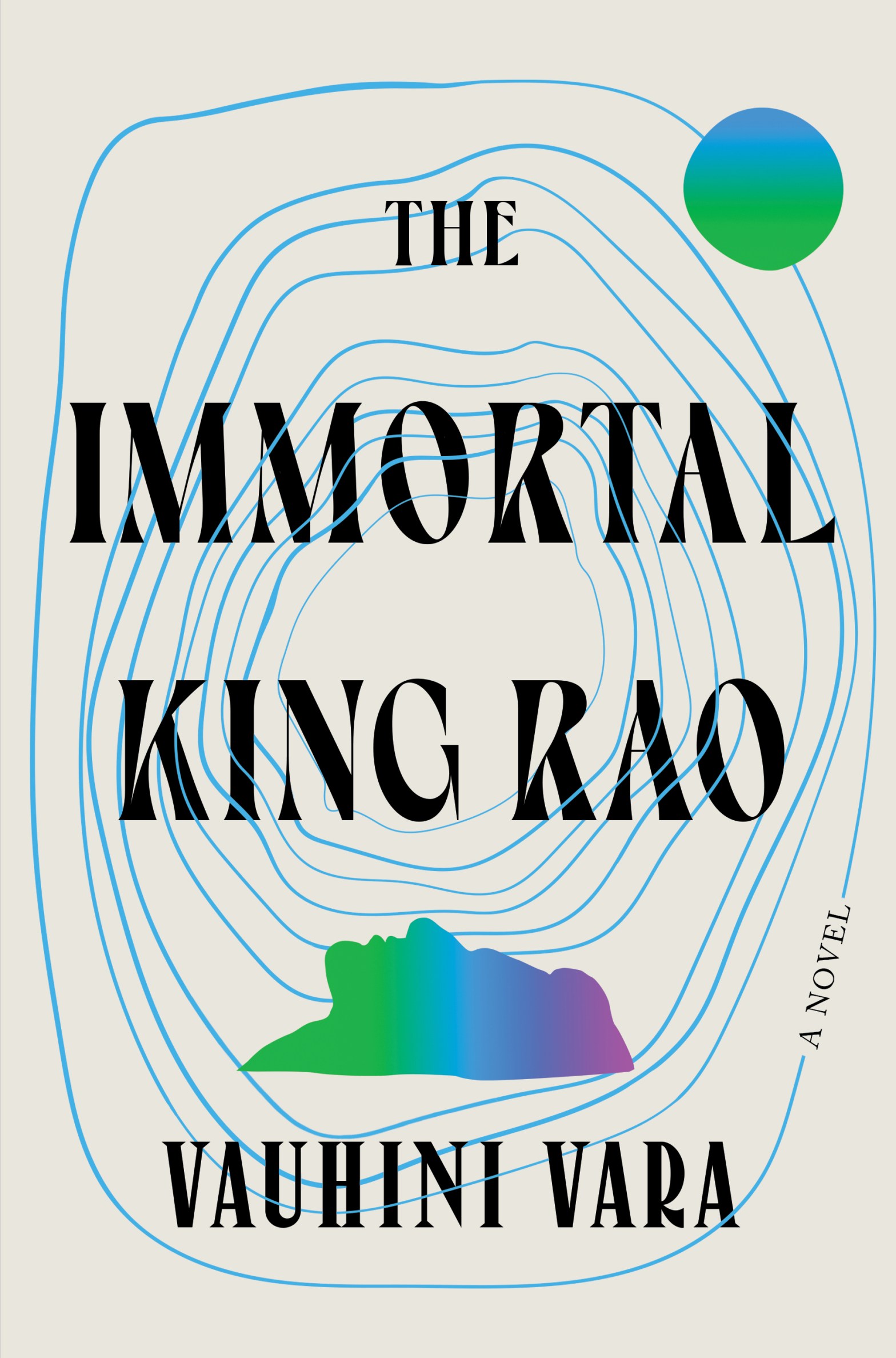
The Immortal King Rao (2022) by Vauhini Vara was a finalist for several literary awards that year, and I can see why. It’s a fascinating story to listen to.
Following King Rao, born a Dalit in India in the 1950s, on his family’s coconut farm, through his emigration to the United States and the tech advances of the 1980s, which he is in the forefront of, the story jumps to the near-future, where “the algo” governs every aspect of people’s lives, but our only perspective in that time is a young girl who grew up on an island alone with only her father, and is now in jail awaiting her fate for something we do not know.
The girl, Athena, is the daughter of King Rao himself, who is elderly and exiled at that time. She has no “social” profile, as though they have access to the entire internet, Athena and King do not participate in it any more since his exile. But King has given Athena his biggest invention–a way for the entire internet to be accessible to her brain through a neural link–what they call her “harmonica.” And as she reaches adulthood, he uploads his own memories as well.
But Athena can’t stay on the island–as all young people do, she wants to make her own way. So she swims to the nearest island a mile or two away, which is populated by the “X’s”–those people who have opted out of the algorithm and corporate governance, instead forming their own society based on bartering and services not made available by the algorithm. Not ever having been around people, she is awkward and unsure.
Although I enjoyed the audiobook and was completely engrossed in it, I think it might be better to read as an e-book or on paper, as looking at other reviews I may have missed some details. It’s a unique combination of historical family drama–not just King’s family in India, as Athena has access to his memories–with the building of his business, Coconut (an Apple/Amazon-like combination)–with a techno-thriller and aspects of climate dystopian fiction as well.
I do recommend it, and don’t recall anything explicitly anti-fat, but it was a long audiobook and sometimes anti-fat references fly by at 1.25 or 1.5 speed, without me being able to note them anywhere.

