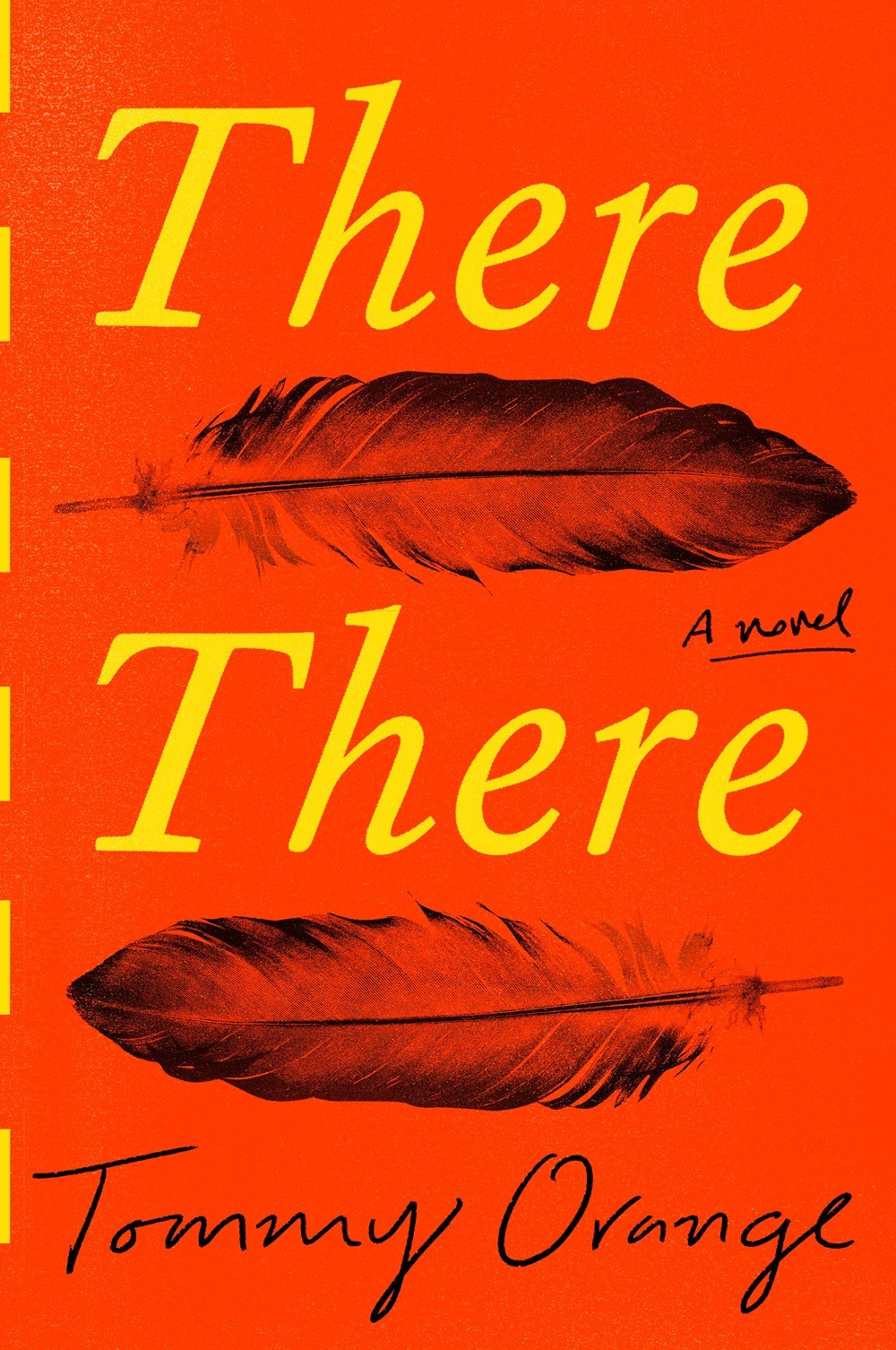
I didn’t get to multi-award winning There There (2018) by Tommy Orange when it came out, but am glad that I finally made the time to listen to it. The audiobook is narrated by Darrell Dennis, Shaun Taylor-Corbett, Kyla Garcia, and Alma Cuervo, and I’m so glad the publisher decided to use multiple narrators, as the perspectives shift and change regularly among twelve characters and points-of-view, and I think I would have gotten lost if the actual voices had not been different. The paper and e-book has a list of characters at the beginning, which is helpful.
As a preface, this book covers difficult themes and I can’t call it fat-positive, although there are fat characters. The writing is very well-done, and Orange tells the stories of native Americans who don’t live on reservations, but live in Oakland, California. The title comes from the Gertrude Stein quote about Oakland, that there is no “there, there” but it’s not a dig on Oakland–it’s that things have changed so much from when she lived there as a child that she doesn’t recognize it anymore, and Orange likens that to how all of the Americas is to native people.
All of the characters have some connection to the “Big Oakland Powwow” — whether as performers, staff members, attendees, or those who participate in a plot to rob it for the prize money, sneaking in 3-D printed guns and everything. At the beginning, it is difficult to see how the characters are connected, but Orange skillfully gives the reader just a little bit at a time until it’s clear that they are all connected, not just by the events of the Powwow.
As I always say, I think it’s important for white people to read books written by people of color, because it is one way for us to have some comprehension of the things people of color have had to deal with and a way to gain some understanding. We (white people) will never truly understand, but in order to be good allies we need to have empathy. Reading is one way to build empathy for people who don’t have the same experiences we do because we have a direct brain link to the point of view of the character we are reading.
So I recommend There There for that reason.
However, I have to consider it anti-fat biased because of the way Orange has written about the character of Edwin Black, a young man who lives with his mother, and who is biracial–white and Native American. Orange has written Edwin as struggling with digestive issues, along with being very large and struggling with figuring himself out after having graduated from college. It’s not a positive portrayal and the culmination of the chapter is humiliating. So beware that the anti-fat bias is not frequent, but significant and off-putting. Orange could have made different choices for that character that didn’t reinforce anti-fat bias. For that reason, I will be skipping Wandering Stars, his second book, which includes some of the same characters.

