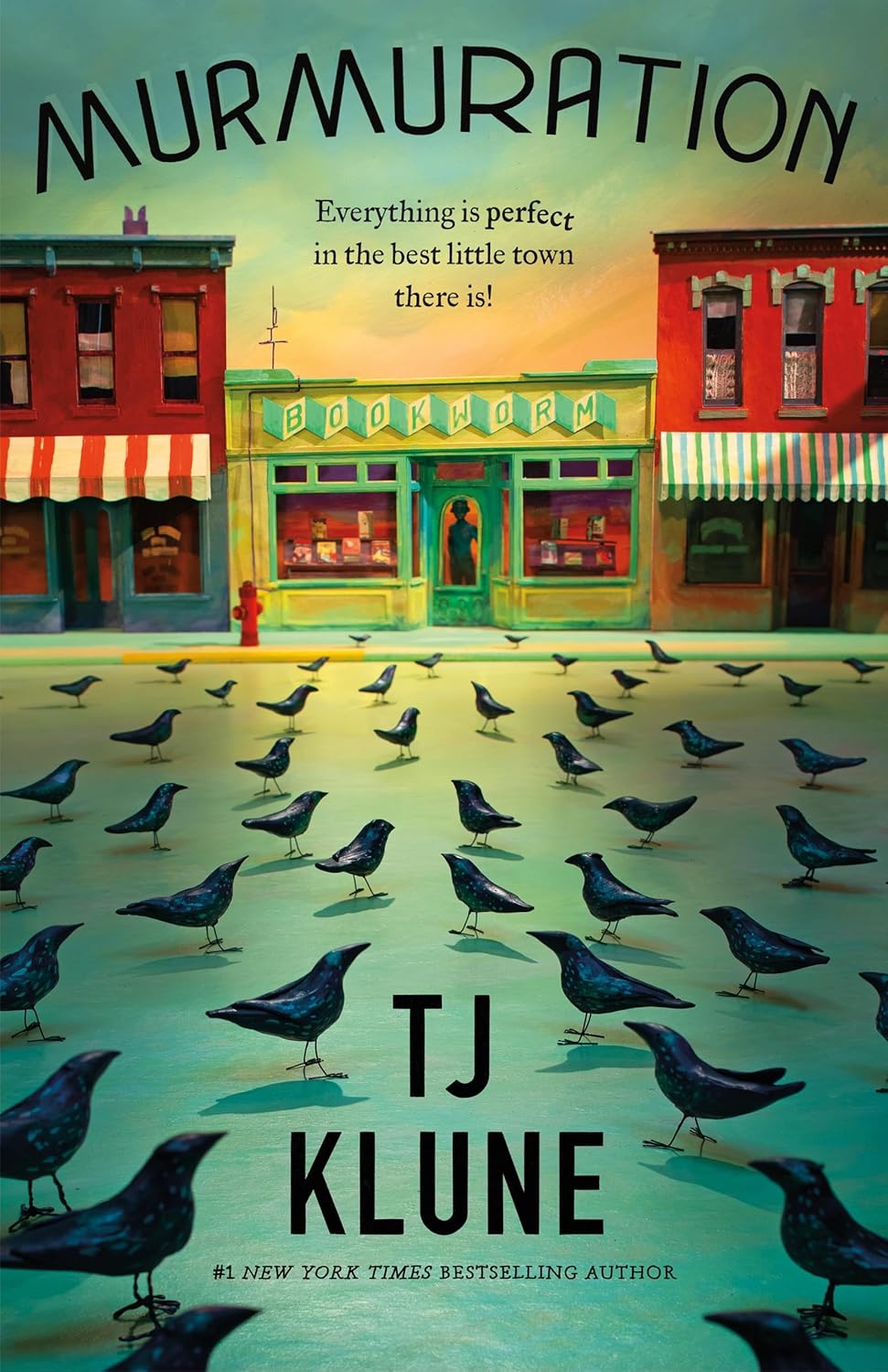
Murmuration (publication day November 17, 2026) is a re-release by Tor of a 2016 T.J. Klune book published by an indie press. It is brilliant and queernormative and I’m grateful to NetGalley for the e-ARC.
It’s 1954 in the small town of Amorea. Mike Frazier, 36, is a bookseller with a cat, who has been very slowly (with the support of the entire town) courting a server at the diner, named Sean, has a weekly poker game and hosts a monthly book group. Everyone in the town is friendly, there’s no crime, and the only problem is that sometimes Sean gets migraines. Otherwise he’s taking his time with Sean, walking him home from the diner every evening, and listening to his radio show every Sunday from his recliner.
But then strange things start happening . . . he hears things that don’t make sense, like someone being in his house, and his friend Oscar tells him about a woman he loved that is no longer here, and Oscar is desperate to tell Mike about her. And then Oscar just disappears in front of him, and then no one can remember Oscar the next day. Mike starts remembering things that happened before he came to Amorea, and feeling emotions that don’t fit in Amorea–anger, and grief–and no one is angry there, everyone is always perfectly nice.
He tries to leave Amorea, but cannot. And he realizes that there are no children, no horses, no children, no cars, no hospital. No one ever comes to visit. He goes to the doctor, who suggests that maybe he has schizophrenia, and Mike is terrified because he keeps seeing things that aren’t there, and seeing murmurations of starlings.
I don’t want to say too much more to avoid spoilers, but I was completely hooked and had to know what happened. Klune did not disappoint–Murmuration is a stellar speculative fiction story–he explains in the acknowledgements that Murmuration was his attempt at writing an episode of The Twilight Zone. It was disturbing, full of yearning and nostalgia, and sweeping romantic love. Amorea is definitely not what it appears, and neither are its residents. It is such a good read!
I consider it weight-neutral, as there isn’t any explicit anti-fat bias or diet culture.

