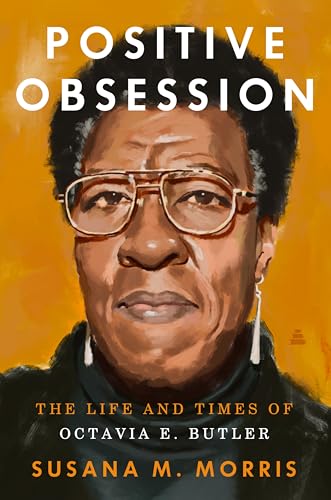
Positive Obsession: The Life and Times of Octavia E. Butler (2025) by Susana M. Morris is one of the best biographies that I’ve read, about one of the most amazing authors of speculative fiction that ever lived. Although I’ve not reviewed any of Butler’s work in this space (that’s changing next week with a review of Fledgling, her last novel), over the past 15-20 years, I’ve read every book she published.
It is not an overstatement to say that she was one of the great thinkers of our time and that she is greatly missed since her death in 2006. Many readers know her most popular works–Kindred, about a black woman in the 1970s who inexplicably time travels back and forth to the 1800s where she is enslaved–and the Parable series, which is a post-apocalyptic vision of the United States after a religious dictatorship takes over. In the Parable series, Butler conceived not only a world that is so similar to our current reality as to be prescient, but she invented an entire religion that makes so much sense–that the only constant is change, and that in order to live fully, we must embrace it.
In Positive Obsession, Morris delves deep into Butler’s archives and personal papers to share who Octavia E. Butler really was, and sets her work in the broader context of what was happening in the world at the time. The title comes from Butler’s own description of her desire to write and share her work a “positive obsession”–something she was not able to stop from doing. While she was alive, Butler admitted to being dyslexic, but she may have also been neurodivergent in other ways, as she struggled with social cues for her entire life, despite being a keen observer, as evidenced by her novels.
Butler was raised in Southern California in a working-class family who had migrated from Louisiana during the Great Migration with their extended family. Her mother was a domestic worker, and Octavia worked her own way through college, as she had started writing when she was a young girl. Morris traces Butler’s papers through her hard work and trying to break into publishing in the 1970s, through her commercial successes and awarding of her first Hugo and Nebula awards and her awarding of a MacArthur Foundation “Genius Grant” in 1995. She died at age 58, in 2006, far too soon.
I can’t really say enough about Morris’s biography and about Butler’s work–I am so grateful for both and for living in a time where we can all learn from their perspectives as black women. My reading life is so much richer for it.
Overall, I consider it weight-neutral. Butler is described as very tall and awkward (as she described herself), but there is no negative descriptions of her body size or weight.


One thought on “Positive Obsession: The Life and Times of Octavia E. Butler”