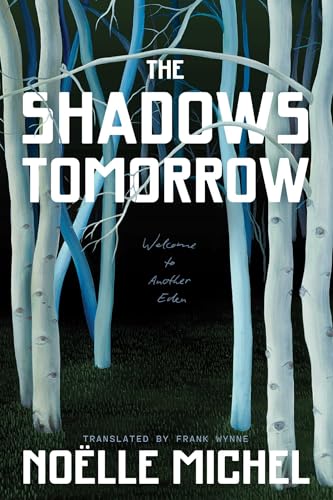
The Shadows Tomorrow, by Noëlle Michel, translated by Frank Wynne (English translation publication day August 4, 2026, originally published in French in 2023) will bring forth concurrent emotions of both despair for humanity and relief that there are some people who still embody goodness.
Set in the near future, anthropologist Eva, with a specialty in the development in language and culture in early hominid societies, is approached by a private institute to work on a new project, complete with a lengthy NDA, run by a famous billionaire. His institute has cloned Neanderthal DNA, and Eva will be the one who plants the seeds for the myths and legends for the clan-to-be. She’s assured there will be no experiments, and the clan will be living on a preserve away from homo sapiens. She is strongly considering going into the preserve with them, at least until the first Neands are able to care for any children that come about.
The story then jumps forward about 40 years later to the perspective of Adam, a young man living with his father and autistic brother, who spends too much time on his VR headset. His sister Victoire is something of an activist, but he’s just gotten a callback for a part in Another Eden, a reality show that streams worldwide, that follows the clan of Neands in their reserve.
Interspersed with Eva’s and Adam’s perspectives are that of Blood Moon, a Neand woman with nearly-grown daughters, and Azure, a young man, who are in the Neanderthal clan on Another Eden. We get a few more perspectives as the plot progresses, but this quote is the ultimate question of the book:
How can two species be equal when the first one plays God and creates the other for its own amusement?
I was enthralled and couldn’t wait to find out what happened. That being said, there are some issues–the first being that the time-jumps between the near future and 40 years ahead are sometimes hard to follow. And there is some gratuitous diet culture and anti-fat bias that wasn’t really necessary–the author or translator could have made their point without resorting to that. But I still recommend it as an excellent dystopian/ speculative novel with those reservations.

