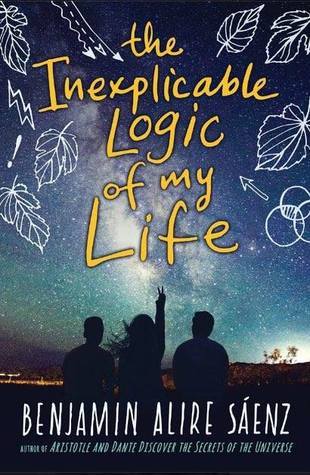
The Inexplicable Logic of My Life (2017) by Benjamin Alire Sáenz sat on my shelf for years until something called me to pick it up in July 2026. I had loved the author’s earlier Aristotle and Dante Discover the Secrets of the Universe, which I had read in 2016. I was sad to find out that Sáenz died right around the time I was reading Inexplicable Logic.
Sal is a senior, and he’s happy with his life, being the adopted son of a gay father, Vicente, who was his deceased mother’s best friend, and spending time with his larger Mexican-American family. His best friend for years is Samantha, who is smart and snarky and brave. But he feels change coming on the horizon, and sometimes he can’t control his temper in defense of other people. He’s not sure he know who he is.
Sam is not getting along with her mother, Sylvia, when Sylvia dies in a car accident, upending Sam’s life–her father has never been involved. She moves in with Sal and Vicente, with the approval of her aunt. Sal’s Mima (grandmother) is ill with cancer, and Sal is having feelings about everything. Sal and Sam befriend Fito, a boy in their grade who has a terrible family life–his mother is an addict, he works all of the time so he doesn’t have to go home, and he’s always hungry. And Vicente wants Sal to work on his college application essay–he has no idea what to write about.
And also, Vicente tells him that his mother left him a letter before she died, with information about who his biological father was. What is he supposed to do with that? Is his genetic legacy the reason he is always throwing punches now? He doesn’t even remember his mother–his Mima is the only mother figure he knows, and she’s dying.
There are so many things going on in this novel–it is so beautiful and full of wisdom and spirituality and grief. The writing is superb and the characters are rich and complicated. It made several annual lists–NPR, ALA, Kirkus Reviews, so don’t miss it, even if you don’t typically read young adult novels. The characters are mature and thoughtful and not whiny at all like in some YA novels. I had to order four more of Sáenz’s books so that I have them to savor. I can’t wait to read his poetry.
And it was completely weight-neutral, with no negative mention of body size.

